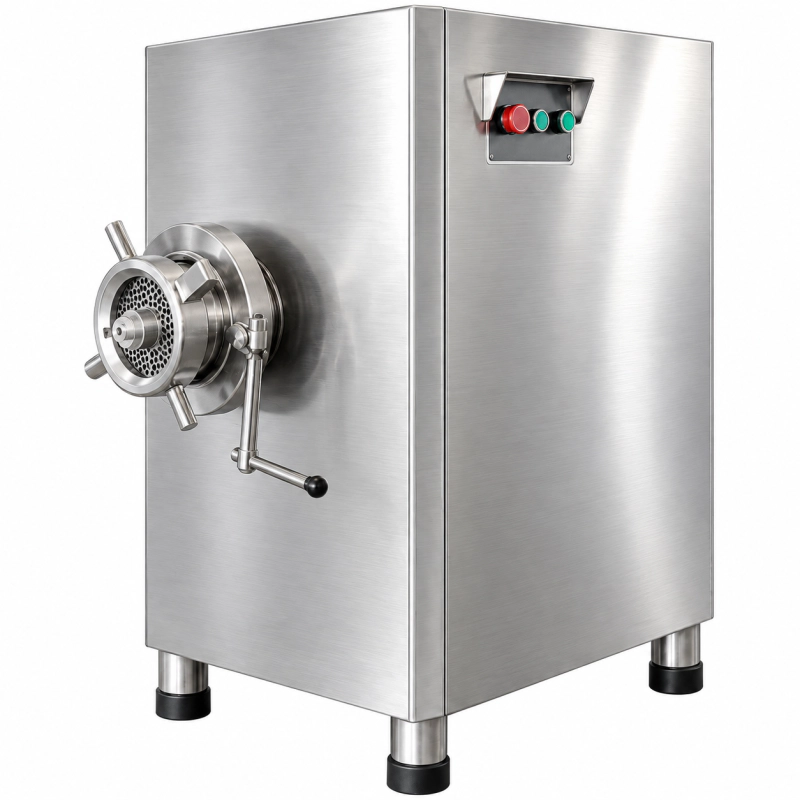
เครื่องบดเนื้อแช่แข็งและเนื้อสด รุ่น JR
JR Series frozen and fresh meat grinders — 1.0–12 t/h, gearbox transmission, −18°C frozen grinding without thawing, full stainless steel. JR-D120 / D200 / D300 industrial meat grinders. Quote in 24 h.
The JR Series Frozen and Fresh Meat Grinders are full stainless steel, gearbox-transmission meat grinding machines covering capacities from 1.0 t/h to 12 t/h across three models — capable of grinding frozen meat at temperatures as low as −18°C directly without thawing, producing meat particles of different specified sizes while preserving muscle fibre structure, nutritional content, and natural flavour.
With powerful motor, gearbox transmission, low failure rate, and high efficiency, the JR Series is a necessary piece of equipment for food processing — cutting frozen or fresh meat directly into different-sized meat particles without destroying muscle fibre tissue, keeping meat temperature rise minimal, preserving freshness, and extending shelf life. An essential preparation step for chopping and mixing upstream of sausage filling, emulsification, and meat product manufacturing. Also known as: industrial meat grinder, frozen meat grinder, commercial meat mincer, meat grinding machine, JR-D120 meat grinder, JR-D200 meat grinder, JR-D300 meat grinder.
⛄ Frozen Meat Processing
🏭 Meat Processing
📈 1.0–12 t/h Capacity
🌎 Export / OEM
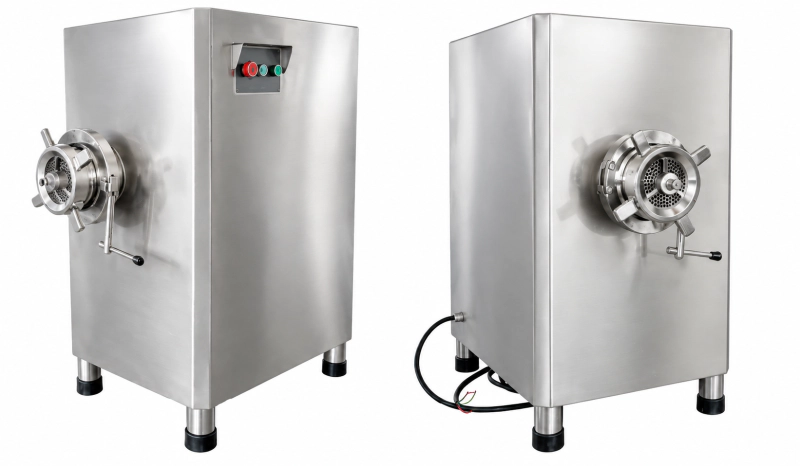
Technical Specifications — All Three Models
Full verified parameter set for the JR-D120, JR-D200, and JR-D300 frozen and fresh meat grinders. All power supply standard is 380V / 50Hz.
| Parameter | JR-D120 | JR-D200 | JR-D300 |
|---|---|---|---|
| ความจุ | 1.0–1.5 t/h | 2.0–3.0 t/h | 6–12 t/h |
| Power | 7.5 KW | 37 KW | 55 KW |
| แหล่งจ่ายไฟ | 380V / 50Hz | ||
| Auger RPM | 246 | 170 / 260 | 47 |
| Machine Weight | 300 kg | 1,750 kg | 2,100 kg |
| Overall Dimension (mm) | 950×550×1,050 | 1,800×1,500×1,700 | 2,280×1,210×1,800 |
| Frozen Meat Capability | −18°C and below — no thawing required | ||
| Body Material | Full stainless steel — all food-contact surfaces and machine body | ||
How the JR Series Meat Grinder Works
The JR Series uses a gearbox-transmission auger system to feed, compress, and force meat through interchangeable perforated plates at controlled speed — the same fundamental mechanism as all commercial screw-type meat grinders, but engineered specifically for frozen meat at −18°C and high-throughput industrial operation:
① Gearbox Transmission — Low Speed, High Torque
The motor drives the auger through a gearbox transmission system rather than a direct-drive or belt arrangement. Gearbox transmission converts motor speed to the low RPM / high torque profile required for frozen meat grinding — where the auger must apply very high force to advance frozen product against the resistance of the perforated plate without stalling. The JR-D300’s 47 RPM auger speed versus the JR-D120’s 246 RPM reflects this scaling: larger frozen meat loads require lower speed and proportionally greater torque to maintain consistent feed without block-and-release events that damage the grind quality.
② Frozen Meat Processing at −18°C
Frozen meat can be fed directly into the JR Series grinder without prior thawing — including meat blocks frozen to −18°C and below. The high-torque gearbox drive maintains consistent auger feed force even against the elevated resistance of fully frozen product, reducing the frozen meat block to consistent-sized particles without destroying muscle fibre structure. This no-thaw capability eliminates the 12–24 hour thawing cycle that conventional meat grinders require before processing, directly reducing production time and cold chain handling cost per tonne.
③ Perforated Plate Particle Size Selection
The particle size of the ground meat is determined by the hole diameter of the interchangeable perforated plate installed at the grinder head. Plates with different hole diameters produce different meat particle sizes — fine for emulsified sausage, coarser for fresh or cooked sausage products requiring visible meat texture. Plate change between production runs is fast and tool-minimal, and the JR Series accepts a standard range of commercial plate hole sizes. Plates ship with each machine, with additional sizes available as accessories.
④ Minimal Temperature Rise — Freshness Preservation
The low-speed, high-torque auger and gearbox system minimises frictional heat generation during the grinding cycle — keeping meat temperature rise minimal and preserving the natural colour, flavour, and protein structure of the ground meat. This is particularly important for frozen meat processing, where controlled grinding temperature directly affects the quality of the downstream sausage emulsion and the shelf life of the finished product.
6 Core Advantages of the JR Series Meat Grinder
Structure & Material Specification
Machine Body & Food-Contact Surfaces
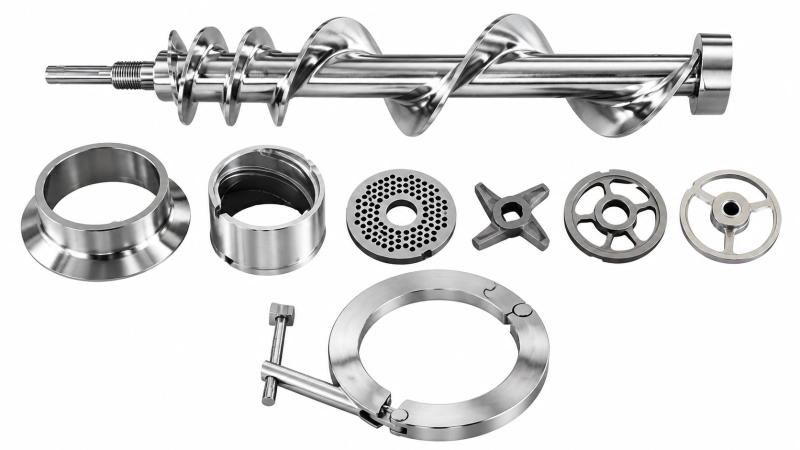
The entire JR Series machine — body, hopper, auger housing, auger, knife, and perforated plate — is manufactured from full stainless steel. No cast iron or mild steel components appear in any food-contact zone. The stainless construction resists the corrosion caused by meat acids, cleaning chemicals, and the sustained low-temperature environment of frozen meat processing, and meets commercial food processing hygiene standards for daily high-pressure washdown.
Gearbox Transmission System
The gearbox provides the torque multiplication required to drive the auger through frozen meat at low RPM without motor overload. The gearbox transmission approach is why the JR Series achieves a low failure rate under sustained heavy-duty operation — the motor runs within its rated load at all times because the gearbox converts motor output to the exact torque/speed profile the auger requires, rather than demanding the motor itself absorb load spikes from frozen product resistance.
Auger, Knife, and Perforated Plate Assembly
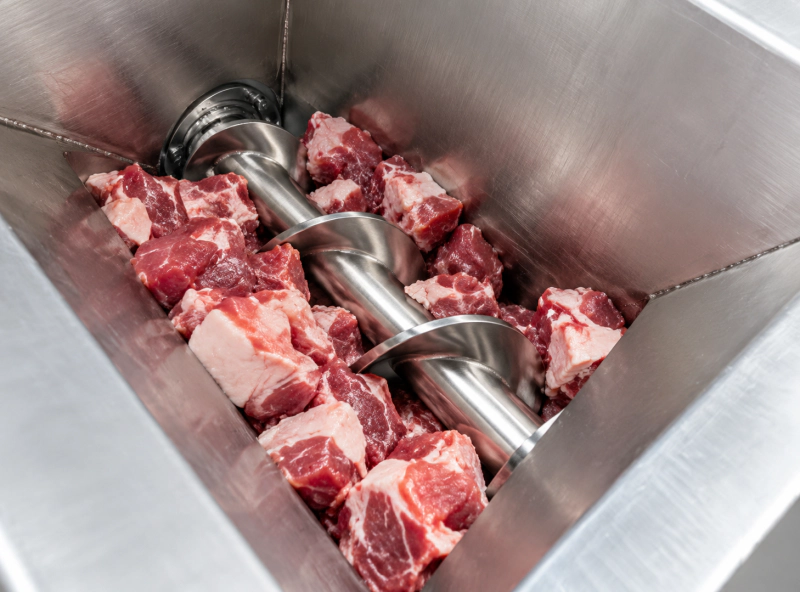
The stainless steel auger feeds meat from the hopper to the knife and perforated plate at the grinder head. The knife rotates against the perforated plate — meat is forced through the plate holes by the auger pressure, and the knife shears off each portion as it exits the hole. This produces consistently sized meat particles across the full operating speed range. Different plate hole diameters produce different particle sizes; plates are interchangeable without tools in a standard commercial maintenance procedure.
Hopper & Feed System
The stainless steel hopper accepts fresh or frozen meat blocks directly. The hopper geometry is designed to support the weight of large frozen blocks without deforming the feed channel and to maintain continuous feed to the auger — avoiding the stop-start feed events that cause overload spikes in smaller machines not designed for frozen product. The JR-D300’s 6–12 t/h capacity requires a proportionally large hopper and auger diameter to maintain steady feed at this throughput rate.
Typical Application Scenarios
The JR Series is deployed wherever meat particle preparation is required upstream of sausage filling, mixing, or emulsification:
🌭 Sausage Production Preparation
First-stage preparation of fresh or frozen meat before sausage filling, emulsification, and bowl cutting. Consistent particle size from the grinder is the foundation of consistent sausage emulsion quality — variations in grind size produce variations in finished product texture and bind.
⛄ Frozen Block Processing
Direct grinding of −18°C frozen blocks eliminates the thaw cycle — allowing frozen imported raw material to be processed immediately upon receipt without 12–24 hours of temperature management, drip loss, and refrigeration space for thawing.
🍕 Fresh Meat Mincing
Fresh pork, beef, chicken, and mixed protein mincing for fresh sausage production. Low temperature rise preserves the natural colour and flavour of fresh meat — critical for retail fresh sausage products where appearance at point of sale drives purchasing decisions.
🥛 Pre-Emulsification Grinding
First-stage coarse grind before bowl cutter emulsification. Consistent coarse particle size from the JR Series ensures the bowl cutter’s cutting knives encounter uniform product load — producing more consistent emulsion particle size and texture in the finished sausage.
🏭 Multi-Protein Mixed Products
Mixed pork-beef, pork-chicken, and other multi-protein formulations for cooked sausage and lunch meat. Different proteins may be ground separately on different plate sizes and then blended — the JR Series supports this multi-product workflow across its full model range.
🏭 Large-Scale Industrial Processing
The JR-D300 at 6–12 t/h suits large-scale industrial meat processing plants running continuous multi-shift operations — the gearbox transmission and full stainless body are built for sustained heavy-duty use at this throughput rate without fatigue failure or hygiene compromise.
Model Selection Guide
Select the JR model that matches your daily grinding requirement and production shift pattern:
| Scenario | Recommended Model |
|---|---|
| Small/medium sausage factory — up to 1.5 t/h grinding requirement | JR-D120 |
| Mid-scale meat processor — 2.0–3.0 t/h or two-shift small factory | JR-D200 |
| Large-scale industrial plant — 6–12 t/h continuous multi-shift grinding | JR-D300 |
| Primarily frozen block processing (−18°C and below) | All three models suitable — confirm capacity |
| Multiple particle sizes required on same line | One machine + interchangeable plate set |
What to Tell Us at Enquiry Stage
- Target hourly grinding capacity (tonnes/hour) and number of production shifts per day
- Meat type and condition — fresh only, frozen only, or both; block size and typical temperature
- Required particle sizes — which plate hole diameters for your product formulations
- Downstream equipment — bowl cutter, vacuum mixer, or direct sausage filler, so we can confirm output particle size compatibility
- Power supply — 380V/50Hz standard; confirm local supply standard if different
Performance Comparison — Industrial Frozen Meat Grinders
| Criteria | Seydelmann K Series (Reference only) |
Mado MEW Series (Reference only) |
JR Series (This Machine) |
|---|---|---|---|
| Frozen Meat at −18°C | ✔ | ✔ | ✔ |
| Gearbox Transmission | ✔ | ✔ | ✔ |
| Full Stainless Steel | ✔ | ✔ | ✔ |
| Max Capacity | Up to ~8 t/h | Up to ~6 t/h | Up to 12 t/h (D300) |
| Models Available | Multiple | Multiple | 3 models (D120/D200/D300) |
| Spare Parts Lead Time | 2–6 weeks (Europe) | 2–6 weeks (Europe) | 3–5 working days |
| Estimated FOB Price | USD 30,000–80,000+ | USD 25,000–70,000+ | Contact us for quote |
Summary: The JR Series matches the core technical capability of leading European frozen meat grinders — full stainless, gearbox transmission, frozen meat at −18°C — at a significantly lower capital cost, with the JR-D300 reaching 12 t/h capacity that exceeds comparable European models, and spare parts available in 3–5 working days versus 2–6 weeks.
Order Information & Trade Terms
📦 MOQ & Order Flexibility
Minimum Order: 1 unit.
Sample Policy: Factory inspection or 1-unit trial available for new customers under appropriate conditions.
Mixed Orders: Combine with other equipment; orders totalling ~USD 1,500+ qualify for mixed-order pricing.
Includes: One set of quick-wear spare parts and one year warranty with every machine.
🚚 Lead Time
JR-D120: 10–20 working days after order confirmation.
JR-D200: 15–25 working days.
JR-D300: 20–35 working days.
Complete line projects: 45–120 working days depending on scope.
💳 Trade Terms
Standard: EXW, FOB, CIF, DAP.
Available on request: FCA, CFR, CPT, CIP, DDP.
TT (wire transfer) and LC accepted.
🛡 After-Sales & Warranty
Warranty: 12 months full parts from delivery date.
Quick-wear parts: One set ships with every machine.
Replacement parts: Dispatched within 3–5 working days globally.
After-sales: Dedicated team visits customers periodically and resolves production issues promptly.
Third-Party Supplier Verification — SGS / TUV Rheinland
We have completed a third-party supplier audit and company verification supported by SGS and TUV Rheinland, covering company identity, business operations, supplier profile, and manufacturing capability. Product-specific inspection reports, material certificates, and compliance records can be provided per order requirements.
Frequently Asked Questions
Get a Quote for the JR Series Meat Grinder
Whether you are adding a frozen meat grinding station to an existing sausage line, replacing an ageing grinder, or building a complete meat processing facility, our team will send a tailored model recommendation and commercial proposal within 24 hours.
We supply meat processors, equipment distributors, and engineering contractors across Russia, CIS, Europe, Southeast Asia, and the Middle East. Our SGS/TUV Rheinland supplier verification gives your procurement team the documentation needed to approve the purchase with confidence.
Grind Frozen Meat at −18°C — No Thawing Required
Tell us your daily grinding tonnage, meat type, and required particle sizes — we will recommend the right model and send full pricing within 24 hours. No obligation.